
I’ve been regularly asked a question that should be straightforward: “Can you inspect my house?” The answer? Well, no. But maybe yes.
In Queensland, a unique legal requirement governs pre-purchase building inspection reports. If you want to provide a residential inspection report that complies with Australian Standard AS 4349.1, the one specifically designed to help buyers make informed property decisions, you must hold a licence issued by the Queensland Building and Construction Commission. No other state applies this requirement in quite the same way.
At face value, this sounds like good news for consumers. It means inspectors are licensed, which should imply competence. But when you look more closely, the system starts to reveal serious problems.
The Flawed Logic of Licensing
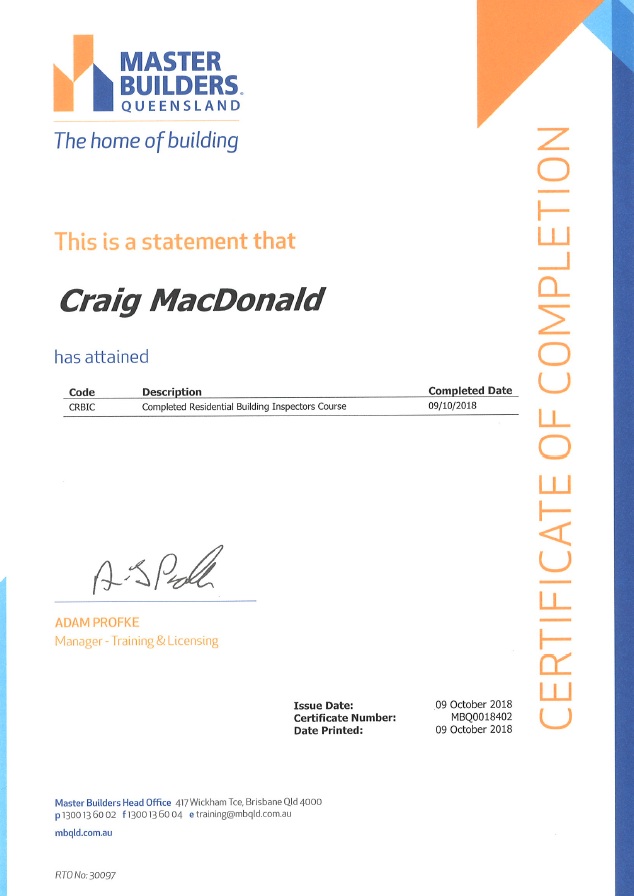
Under the current Queensland Building and Construction Commission rules (QBCC) you can obtain a “completed residential building inspection” licence if you have done a two-day course and already hold a builder’s licence. In practice, this means most inspectors are former builders who have moved off the tools. I’m not just saying that – I attended and completed the two day course – and when asked one by one why everyone wanted to complete the course, I was the odd one out. The first person was someone in their 40s “just need to get off the tools hey”, then the next person possibly older with an even more creative answer, “yeah, same”, then the next maybe older than 50, “Same.”
“Same.” “Same.” Like 20 times over. I was the odd one out. I really can’t remember what answer I gave, but it was along the lines of expanding my credentials and getting CPD.
The irony is that a highly experienced chartered building surveyor, someone with a postgraduate qualification, international recognition and experience advising investors, banks and institutions on complex buildings, has no clear way to obtain this same licence. Unless they also hold a builder’s licence and take the same two-day course, they are effectively excluded.
Put simply, the system is built around the construction industry, job titles, and legacy qualifications rather than actual professional competencies.
But Don’t They Have a Licence?
The goal of licensing is to protect consumers. Buyers naturally assume that someone who holds a licence to inspect homes must be qualified to do so. But what if the licence does not reflect what consumers actually need?
The answer lies in the minimum standard that underpins these inspections. AS 4349.1 outlines what should be visually inspected, but it deliberately avoids requiring advice or interpretation. Although the document admits that “independent and objective advice is often required,” it excludes advice from its own scope.
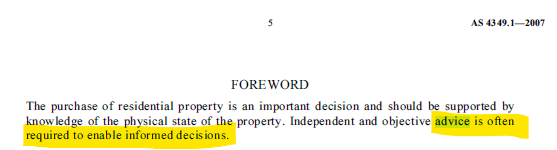
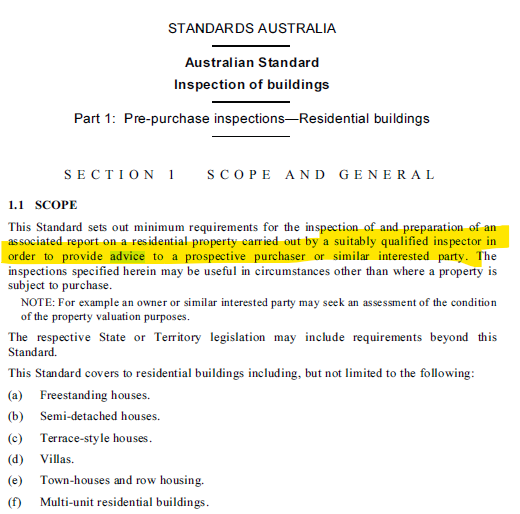
The use of the word advice must be with care; “advice” in the true sense of the term is excluded from the scope of this AS, which reduces the reporting to an experienced person diligently describing their findings with no advice (i.e. next steps) provided. Noting the Standard confirms that it sets out the “minimum” standards for the preparation of the report.
Inspectors are only required to form an opinion on condition. They are not required to identify the cause of defects, suggest next steps or estimate rectification costs. In fact, the standard makes clear that pricing repairs is not within scope.
The Illusion of Protection
Many buyers think they are protected because they have received a report that meets the Australian Standard. But in practice, these reports often fall short of what buyers truly need.
They may tick the box for compliance, but they rarely offer practical or financial context. There is no meaningful advice, no timeline for rectification, and no cost indication. These omissions are not the fault of the inspector. They are built into the system.
Most inspectors are not insured to offer professional advice, and many do not have the training or experience to do so. As a result, buyers are left to interpret technical findings alone, often at the most financially vulnerable moment of their lives.
What the Standard Does Not Say
The standard has significant limitations. It does not include the timeframe or urgency of a defect, even though this is critical information for a buyer. It does not reference “movement” as a defect, despite this being one of the most common issues in residential buildings. It does not require the inspector to determine cause, which is essential for understanding risk and cost.
It also avoids meaningful classifications. The definition of a major defect is vague, with no clear inclusion of time or cost. The definition of a minor defect is simply anything that is not major. Compared to international frameworks such as those used by RICS, this is a blunt tool.
Even though the standard’s purpose includes “providing advice,” the scope outlined in section 2.3.1 makes it clear that no pricing or detailed guidance is required. This disconnect between purpose and scope is at the heart of the issue. Buyers expect actionable insights. Instead, they receive observations without interpretation.
What Needs to Happen Next
RICS has long recommended and lobbied that Queensland’s Department of Housing and Public Works expand the list of accepted qualifications for this licence to include RICS-accredited chartered building surveyors. This would be a positive step.
More broadly, we need a national framework that recognises the core skills needed to conduct condition assessments and provide meaningful advice. The current approach is fragmented, inconsistent and fails to reflect the needs of consumers.
The standard itself also needs an overhaul. It should refer to building classifications used in the National Construction Code. It should strengthen the definitions of defects (currently limited to “major” and ….”minor”). It should offer a higher tier of reporting that includes advice, costs and remediation timelines. These are the features buyers value most.
Until Then: Buyer Beware
In Queensland, a licence is required to issue a residential inspection report under AS 4349.1. But the licensing path does not require deep expertise in building pathology, and the report itself is not expected to include advice.
So when someone asks me, “Can you inspect my house?” the answer depends on whether they want a licensed checkbox report or meaningful insight into the condition and cost risk of the property.
Yes, I can give them clarity, professional advice and answers to the questions that actually matter.
But no, I cannot legally issue them the standardised report unless I obtain a builder’s licence.
CJLM