
Nathan is an accountant who sits on a body corporate committee that manages an apartment complex. In Australia, a body corporate is the legal entity that manages the common property of residential, commercial, retail, industrial or mixed-used properties. They are also referred to as Community Title Strata, or CTS. Variations of this exist in other countries. Common property for these entities can include shared assets like car parks, grounds and lifts.
He doesn’t realise it yet, but Nathan is about to embark on a journey.
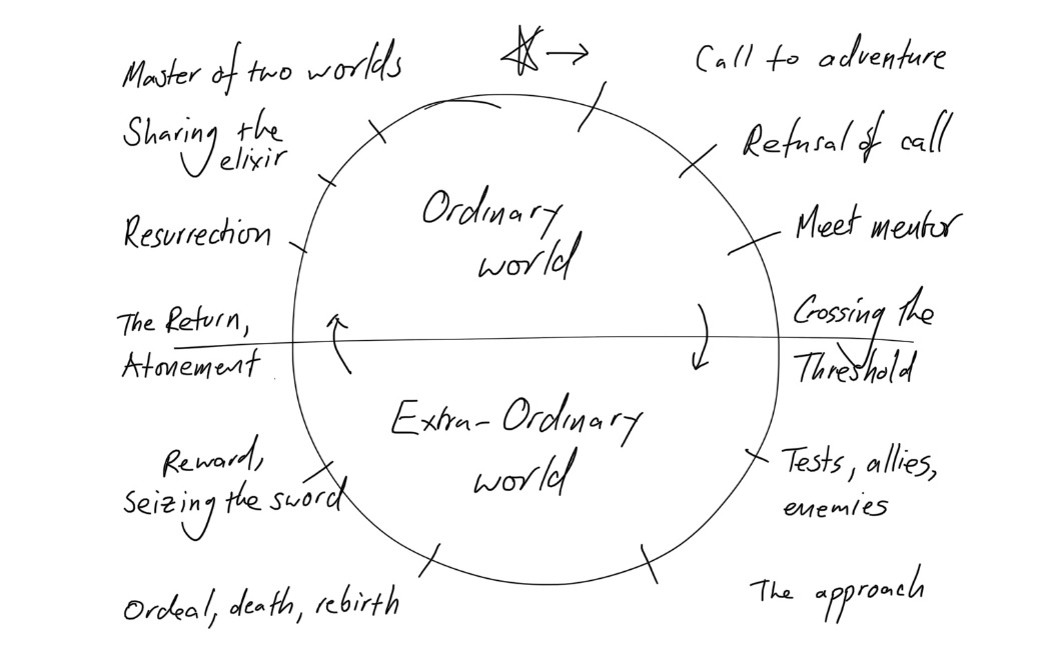
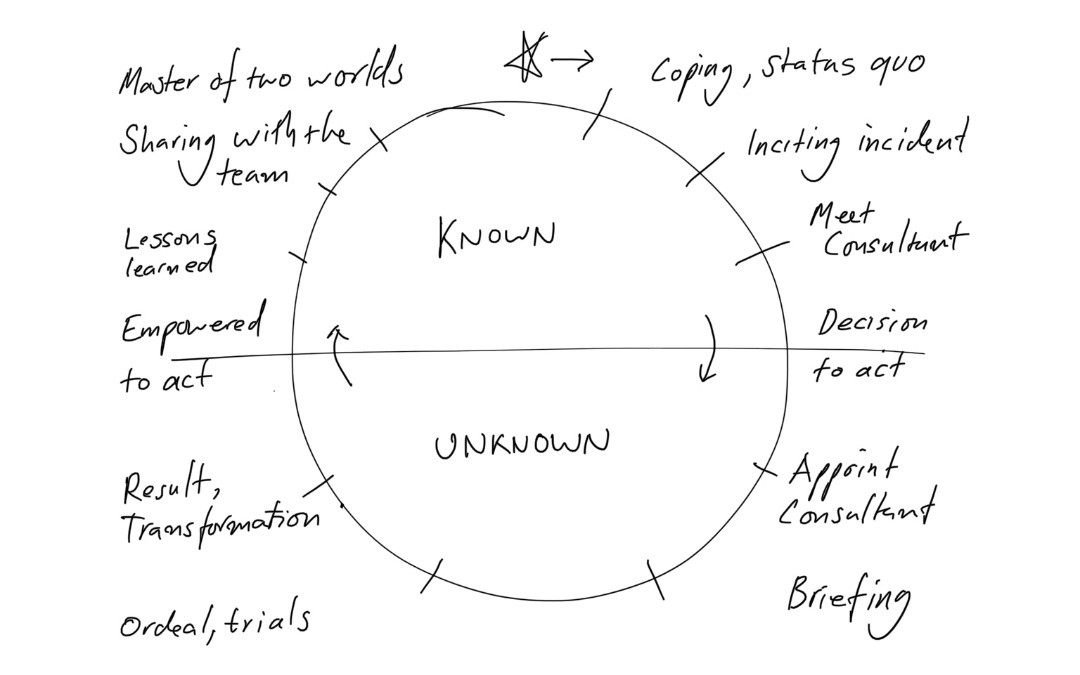
- In Nathan’s ordinary world, life is business as usual and problems are predictable. Nathan is an accountant, and outside of his accounting day job, he sits on a committee that is responsible for the running and upkeep of common areas in an apartment block where he owns one of the apartments. Nathan’s knowledge of buildings stops about there.
- Something disrupts business as usual. Whatever coping mechanisms that may have been in place up to that point no longer work. There is cracked concrete in the car park basement of the 10-storey apartment complex and no one on the committee really knows what this means for the building. The committee is made up of various apartment owners, a diverse mix of backgrounds and professions, but no one works in property or construction.
- Fearing the worst, that the apartment block needs to be demolished, someone on the committee who works in finance concludes they need to first estimate the property’s economic life; that is to ask, what is the cost of the minimum repairs or replacements required to the property, for it to continue to perform as required (as a safe dwelling for multiple residential occupants; and as a stable return on investment for owners), before it is estimated to be more cost effective to demolish and redevelop the site. Nathan is friends with someone who works in a property company in the city and offers to make an enquiry as to who can assist. The committee has made the decision to act. Nathan crosses the threshold into the unknown.
- Nathan makes his phone call to his property friend, asking “is there such a thing as a consultant …for buildings?” His friend is sure there is and knows someone that can help and passes Nathan the details of a building consultant.
- Nathan describes his journey so far to the consultant, he’s not really been exposed to this stuff before and is hoping that the consultant can guide him. He has finally met the mentor of his quest. A mentor in the hero’s journey is an ex-hero himself and has tread this path before. He typically gifts the hero with something he can use on his quest. The building consultant reverse briefs Nathan’s rough requirements, outlining the next steps on his journey.
- Journeying deeper into the extraordinary world of building consultancy, Nathan appoints the building consultant to undertake a full building inspection and to prepare a sinking fund forecast report; a report that predicts the replacement and repair costs to the common property of a strata titled building like Nathan’s apartment block. Upon receipt of the report, Nathan’s fears were transformed into confidence and hope.
- With the report in hand, Nathan journeys back into the known, ordinary, world and tables it at the next body corporate meeting, sharing with the committee the lessons he has learned from his journey into the unknown. The committee now understand, not only that the nature of the cracking is not cause for alarm but is also empowered with an accurate forecast on how to maintain the whole building for the next ten years, ensuring the apartment owners’ annual body corporate fees are being spent wisely and that everyone’s investment is being protected.
Nathan doesn’t realise it, but his journey has come to its end and and he’s become the master of two worlds. This is the Joseph Campbell hero’s journey framework which can be found in any good story you love.
Context is paramount. All of the observations you collate contribute to your context. It will always be possible that you’re missing a critical observation, an important piece of information, something that has the potential to influence context. Context is the circumstances that form the setting and shared understanding of more than one person. For example, Stonehenge is considered to be in a fair condition based on its age, use and location. This is fine because it is likely that between you and I, we already have a shared understanding of Stonehenge’s context.
In most cases, for the buildings we report on, we have to build that context up first to ensure that there is no ambiguity that a shared understanding has formed. We do this using simple, clear language, avoiding platitudes or vague expressions such as “it was REALLY massive”, or “it was quite small”. These are subjective to individual interpretation and provide no benchmark for another’s understanding. Be mindful when using probabilistic language, as it can be interpreted in different ways. For example: “it’s possible”; “unlikely”; and “almost certain”. Any report providing advice and recommendations should include clear definitions of these terms to create a baseline for understanding between the author and the reader. Using ambiguous, subjective, or exaggerated language introduces significant professional risks. If a report is open to varying interpretations, miscommunication can lead to disputes, misunderstandings, or even legal action. Using clear, precise language ensures our findings are understood as intended, protecting both you from unnecessary complications.
This question was received by LookUpStrata:
Our body corporate is in a 25-year-old building in Brisbane. We’ve never had any major defect claims and the building “looks fine,” but a few of us on the committee are starting to notice small signs of wear – hairline cracking on the façade, some staining near balcony edges, ageing sealant around windows. Nothing dramatic, but enough to make us wonder what we’re not seeing.
We’re due for our 10 year maintenance plan review and I want to push for a proper assessment of the building’s actual condition, not just a routine compliance inspection. What’s the difference between the basic safety/compliance reports we’re used to and a more thorough building condition assessment? What would a qualified building surveyor actually be looking for, and is this something we should be doing proactively even without an obvious problem, or is it overkill for a building with no known defects?
A compliance inspection checks against a checklist, fire safety, WHS, accessibility, and tells you whether the building passes today. It’s a reactive thing; identifying immediate risk issues and eliminating them as soon as possible.
A condition assessment on the other hand is strategic. It’s a non-intrusive, high-level examination of all components. It asks why something looks the way it does, and what that means over the next 10 years. It provides the committee with the context to make informed decisions about not just what to spend money on, but in what order, based on risk prioritisation, having confidence to defer items that may otherwise had been replaced/repaired earlier.
CJLM